
The story behind Mundus Foods
Plant-Based Comfort Food Made in Portland for Real Life.
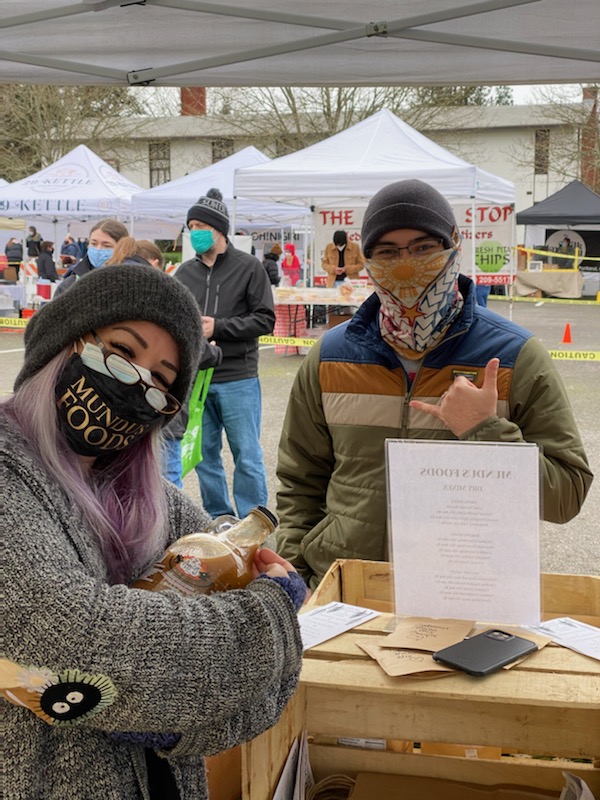
Our aim is to make genuinely wholesome food as transparently as possible. We don’t claim perfection. We’re interested in progress. Our full catalog includes dairy-free creamery products, plant-based baking mixes with gluten-free and no-refined-sugar options, and useful pantry staples designed to leave fewer people out.
It’s food for real households—especially those trying to feed people with different dietary needs, preferences, or ethics at the same table.
Portland-founded. Female- and LGBTQIA+-founded. Built from lived experience, hope, and an unreasonably obstinate love of cheese.
They told me my body was the problem. They were wrong.
How this actually started
For more than 30 years, they told me I had a chronic pain condition.
They also told me food intolerances weren’t real.
Then they told me I had MS.
My life was unraveling. My children were devastated. We were trying to understand what this diagnosis would mean for my body, our family, and the future we thought we had.
Then I learned that all of it was wrong.
I do not have MS. Food intolerances are real. They can be complex, deeply individual, and capable of affecting far more than digestion. Food allergies and certain food-related disorders can also involve the immune system. Medicine has not always been quick to recognize how profoundly food can affect a person’s health. Many of us understood it first through lived experience: our bodies can respond powerfully to foods other people tolerate without difficulty.
Mine had contributed to debilitating pain and disability that had become the fabric determining the shape of my life.
For a decade, I have lived free from the pain and physical limitations I once believed would always control me.
Food matters.
Not simply as an ethical question. Not as performance. Not as another impossible standard against which to measure ourselves.
Food matters because our bodies matter—and each one responds to the world a little differently.
Somewhere in the middle of all this, I was told I couldn’t have cheese.
Compared with MS, that probably should have felt like excellent news. It did not feel like excellent news.
I really, really missed cheese.
So I made my own.
I wasn’t trying to disrupt an industry. I wanted dairy-free cream cheese that tasted like my memories—cultured, comforting, and surprisingly familiar to the rest of my family too.
Then I realized I probably wasn’t the only person standing in front of a refrigerator full of expensive compromises.
Other people missed familiar food too. Other people were feeding families with different dietary needs. Other people wanted to make one meal everyone could enjoy without anyone receiving the sad substitute plate.
What began as an attempt to reclaim one food I loved became something larger: a belief that dietary needs should not make anyone feel punished, excluded, disbelieved, or like an afterthought at their own table.
That kitchen problem became Mundus. Then Mundus became more….
Founded during the pandemic
Supply chains became impossible to ignore.
Mundus began at a moment when empty shelves exposed how fragile our food systems are—and how many people, resources, and consequences remain hidden behind ordinary convenience.
From the beginning, we have had to think about where ingredients come from, who carries the human cost, how the system favors enormous manufacturers, and what today’s convenience asks of tomorrow’s soil, water, and climate.
A supply chain is a relationship, even when the packaging makes it easy not to see one.
That awareness did not become part of Mundus later. It was present from our beginning.
The first proof
It wasn’t just me.
The product I needed in my own kitchen made sense in other people’s kitchens too. Mundus moved from a personal solution to a product on a real grocery shelf—and the larger questions about our food systems became impossible to ignore.
For Mat
Mat believed in everything I ever did.
My brother was my biggest supporter—but that phrase makes him sound much more solemn than he was.
Mat was light and laughter. So much laughter. Enormous, genuine, ridiculous laughter—the kind that spread through a room like wildfire.
Once, who knows why, Mat decided to perform stand-up at an open mic. I didn’t know what to expect when he walked onstage. But he had a routine. He was funny, dorky, nervous, awkward—and clearly loving it.
He didn’t intend for it to become a career. He wasn’t trying to get famous. I think he simply wanted to see himself doing it. To be alive. To experience this world. To try.
So he did.
Mat taught me that how good you are at something is often beside the point. Sometimes the experience itself is the thing that matters. Sometimes you need proof of your own power. Proof that every choice holds potential. Your potential. Even if all you end up doing is making a goddamn fool of yourself while you try to do a thing.
Mundus began before I had any idea how I could build it. I had finally made a cream cheese I wanted to eat. I suspected other people might want it too. I possessed nothing resembling a business plan.
Just cheese and a dream.
Mat was the reason I was brave enough to try—and why I still am.
That is what his belief gave me: not certainty, but permission to make the attempt. To be okay with any outcome. To understand that it’s okay not to start out good at something.
Maybe I won’t change our food systems. But I will have tried.
And that is a life worth living.
Every part of Mundus carries some of that bravery—his bravery—forward. Our willingness to try, to learn, to make the thing we wish existed, and to see ourselves doing what once felt—and, some days, still feels—impossible comes from the example of how he lived and the generosity of how he loved.
What one product revealed
The problem was never just the cheese.
Once you ask why one decent dairy-free staple is so difficult to find, other questions follow rather quickly.
When the food people genuinely need is difficult to find, expensive to buy, or miserable to eat, the problem is bigger than a recipe.
Food freedom is trapped behind a system built to serve scale before people. We challenge that by making food that expands access, respects nutrition, protects flavor, honors the people who produce it, and proves that inclusion does not require compromise.
The system rewards the wrong things.
Shelf life wins over nutrition. Scale wins over locality. Low prices are manufactured by moving the real costs somewhere else, while quality and flavor are sold back to us as luxuries.
Feeding ourselves well becomes easiest for the people who already have the most access.
Different needs should not divide the table.
A dietary restriction should not come with a punishment plate. Plant-based food should be delightful and desirable in mixed-diet households too.
No one should have to choose between what works for their body and what brings everyone together. A genuinely good meal welcomes everyone.
A product can prove another way is possible.
One dairy-free cultured cream cheese became a full catalog of dairy-free creamery products, plant-based baking mixes with gluten-free and no-refined-sugar options, and useful pantry staples made for real kitchens—and for people navigating a system already stacked against them.
Every product that finds its way to a real table becomes another small piece of evidence: food can include more people, be made more honestly, and still be something you are genuinely excited to eat.
Good food is a group project
Sometimes believing something could matter is reason enough to begin.
Mat was right about that. The rest of this story belongs to all of us.